






Gun Reports - News
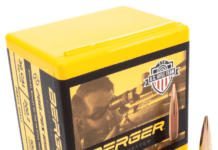
Currently the Berger Hybrid is available in 338 cal and 7mm. They will soon be launching the 30 cal with 6mm and 6.5mm to follow.
Understanding Berger Hybrid Bullets
April 11, 2011Printer Friendly | Email |
(GunReports.com) -- At the Berger Bulletin, accuracy shooters can learn a thing or two about VLDs and the next Hybrid wave of bullets.
According to the Berger Bulletin, the Very Low Drag, or VLD, bullet design was created by Bill Davis, who was one of the top ballistic minds in the late 1980s. His contribution to the shooting sports has made a tremendous impact on how long range shooting has developed over the last two decades. One might think that nothing this good can be improved upon.
Ballistician Bryan Litz recognized both the advantages and disadvantages of the VLD design. He went to work to see if he could keep the good results the VLD produced while reducing its sensitivity to seating depth. His efforts have produced the latest advancement in bullet design the Berger Hybrid.
Background: In the late 80s, the VLD design allowed shooters to use lighter bullets and smaller calibers to achieve the same or better trajectory than heavier bullets in bigger calibers. The concern that this addressed was recoil management. Lighter bullets shot in small calibers were easier on shooters resulting in higher scores and an improved shooting experience.
But, this improvement came with a price. Each shooter had to adjust their load in each rifle until they could get the VLD bullet to shoot precisely. Once the load was dialed in, the VLD was one of the most efficient bullet designs in history. But this didnt stop shooters from yearning for a bullet that is easier to tune.
The Berger Hybrid design incorporates two different shapes within the nose. As the bearing surface ends, a tangent ogive begins. This tangent section of the ogive results in the bullet being much less sensitive to seating depth. Testing results show that the Berger Hybrid shoot equally well at either a jam or a jump.
As you move forward along the tangent portion, the shape changes into a secant ogive. The secant ogive is the shape used on the VLD bullets. This shape is very efficient in the wind and is why the VLD became so popular.
By bringing these two shapes together, Bryan has successfully created a bullet that is both not sensitive to seating depth and shoots very flat like a VLD.
The key to all this is not just the combining of these two shapes, but also the partnership between the ballistician and the bullet maker. Prior to the VLD, other bullets were made with a secant ogive but were not successful like the VLD. It took Bill Davis understanding of how to make the right secant shape work best and Walts ability to make Bills design real and accurately to be successful.
Fortunately for the shooting sports, Bryan has taken on the responsibility of pushing the ballistics performance envelope and Berger Bullets is still capable of taking Bryans design off the paper and putting it in your rifle.
Reader Comments
|
An Important Note for GunReports.Com Readers: Our goal on this website is to foster a free expression of views while reining in language that crosses the line of civil discourse. Accordingly, the comments areas are intended to expand the knowledge of all users of this site. But site administrators wish to discourage the use of profanity, insults, disrespect, the advocacy of lawlessness, violence or sedition, or attempts to impinge on the rights of others. While GunReports.Com encourages robust discourse that furthers our understanding of all the issues affecting gun owners, comments that break GunReports.Com’s rules will be removed. In addition, we reserve the right to edit or delete individual comments, and in extreme cases, to ban commenters at our discretion. --Tim Cole To post a comment you must be a registered user of gunreports.com and be logged in. Use one of the forms below to login or register for FREE to gunreports.com
|